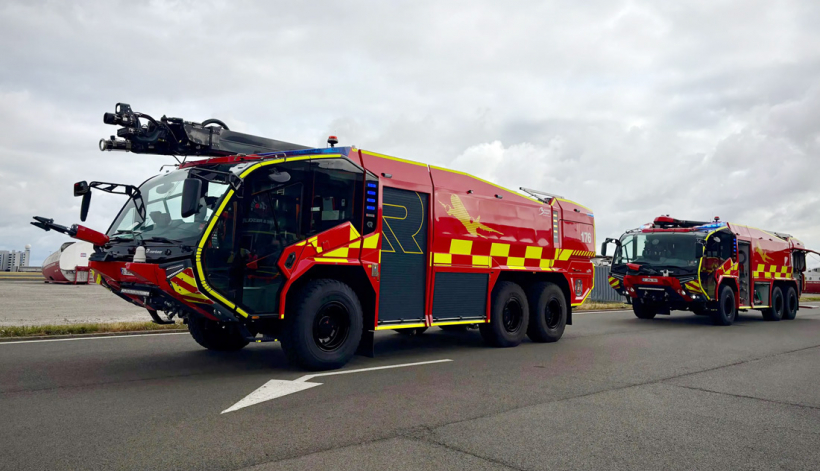
Four brand-new Rosenbauer crash tenders have recently been put into service at Brussels Airport. These powerful fire engines weigh no less than 39 tonnes, have a top speed of 115 km/h and have been specifically designed for rapid interventions on the tarmac.
Each vehicle has a capacity of 12,500 litres of water, 1,500 litres of extinguishing foam and 225 kilograms of dry powder. The roof-mounted water cannons can discharge up to 5,200 litres of water per minute.
One of the crash tenders is also equipped with a piercing nozzle, enabling firefighting agents to be injected directly into an aircraft cabin or cargo hold so that fires can be tackled more effectively.
The new state-of-the-art crash tenders comply with the highest safety standards set by the International Civil Aviation Organisation (ICAO) and the European Union Aviation Safety Agency (EASA).
In addition to the new vehicles, Brussels Airport has also invested in a driving simulator to train future operators. The simulator is fitted with the same cab as the new crash tenders and allows firefighters to practise safely in realistic emergency situations. Together, the vehicles and simulator represent an investment of almost €6 million in the safety of airport operations.
Ready to respond day and night to ensure safety
Brussels Airport's fire service employs 150 colleagues. They work in shifts to ensure that firefighters are available 24/7 to respond immediately to incidents. Their responsibilities include medical emergencies, fire alarms and preventive interventions whenever an aircraft reports a technical issue before landing.
When an incident occurs on the airfield, the fire service must arrive at the scene within three minutes, with at least three crash tenders responding. To meet this requirement, Brussels Airport operates two fire stations, located on either side of the airport. For emergencies in airport buildings, including the terminal, the maximum response time is five minutes.
Following the addition of the new vehicles, the airport fire service now operates a fleet of around 25 vehicles. These include six crash tenders, as well as ladder trucks, pumper trucks, an evacuation stair vehicle and a firefighting robot used to tackle fires in hard-to-reach locations.